While NASA has had some big announcements to come out of its space enterprises in recent years, they have primarily come as the result of long-standing missions that were launched during an era when the organization was better funded, or perhaps better at using its limited funding, to get new experiments off the ground. In the modern era, NASA press releases about new missions usually come in one of two flavors: either the announcement of a ground breaking new mission they drew on a white board and hope someone will pay for, or the inevitable announcement that said mission will once again be delayed.
One of those groundbreaking new missions, the famed James Webb Space Telescope that is slated to replace the aging Hubble as our world’s most powerful lens into the dark expanse of the universe, now falls under that second category, as NASA announced this week that its launch will be delayed nearly year, until the summer of 2019.
According to NASA’s press release regarding the delay, it is required to complete testing on the telescope, particularly its sunshield, despite stipulating that testing has been “going well and on schedule.”
Webb’s spacecraft and sunshield are larger and more complex than most spacecraft. The combination of some integration activities taking longer than initially planned, such as the installation of more than 100 sunshield membrane release devices, factoring in lessons learned from earlier testing, like longer time spans for vibration testing, has meant the integration and testing process is just taking longer,” said Eric Smith, program director for the James Webb Space Telescope at NASA Headquarters in Washington. “Considering the investment NASA has made, and the good performance to date, we want to proceed very systemmatically through these tests to be ready for a Spring 2019 launch.”
This delay places the James Webb in good company, as another of NASA’s major endeavors, the rocket platform that was supposed to end America’s reliance on Russian owned, Soviet era platforms to get them into orbit, has also been pushed back to 2019 “at the earliest.”
The issue with these repeated delays, and their nonchalant treatment of them in the press, is not that America expects its civilian space agency to field underprepared or unsafe equipment, particularly in the case of the SLS (rocket platform) that is expected to ferry astronauts into orbit. The issue is that NASA doesn’t seem to appreciate the importance of public support when competing for a higher budget in the eyes of lawmakers. Taxpayers tend to employ a “what have you done for me lately,” mindset when eyeing the money being pulled from their paychecks, to which NASA can really only respond, “our older missions are still operational!”
NASA’s budgetary limitations are an external factor for which they possess very little control, and the missions they put forward are also subject to external pressures as well. During his congratulations conversation with ISS Commander Peggy Whitson after she’d broken yet another of NASA’s space records, even President Trump told her that he’d like them to expedite their planned mission to Mars, to which Whitson could only respond, “we’ll do our best.” With that in mind, it seems almost unfair to place the blame on NASA for their inability to complete their projected missions within the timeframe they’ve presented. The thing is, lots of government programs are met with delays and overruns, but few are so susceptible to public scrutiny and questioning.
NASA answers to the nation’s lawmakers in much the same way I answer to the editorial staff and organizational hierarchy of SOFREP and its parent company Hurricane. When Brandon Webb, our company’s CEO, or Jack Murphy, the editor-in-chief, provides me with a directive through the chain of command, I’m expected to respond with a realistic estimate of what covering that story will require in terms of resources and time. Those predictions are met with two things from my managing editor: an understanding that a prediction isn’t necessarily a concrete timetable, but also an expectation that my experience and skill set has informed that estimate.
We face this type of pressure in all of our jobs, whether we’re trash collectors or accountants, and it can easy to fall into the trap of offering lower cost, faster timetable estimates for the sake of making our bosses happy… but inevitably, those sunny numbers and dispositions both turn sour when it turns out you can’t deliver on time or on target. If I consistently claimed I could have a story in by Monday, and then kept pushing it out another week as Monday approached, I’d quickly find myself on the hunt for a different line of work.
NASA has been consistently doing just that, however, as the agency’s administration tries to bow to the pressures of its external leadership by producing time tables it simply can’t adhere to. That Mars mission President Trump encouraged Commander Whitson to expedite? It turns out, according to NASA’s chief of Human Space Flight, arguably the guy most qualified to ask about whether or not we can put humans on Mars, he doesn’t even know if it’s possible under the current budget projections.
“We don’t have the surface systems available for Mars,” William Gerstenmaier said in July. “And that entry, descent and landing is a huge challenge for us for Mars.” He went on to say that he wasn’t prepared to offer a date that Americans might actually get there, but he insinuated that it may not be feasible even “through the 2030s.”
It’s worth noting that despite NASA’s resident expert saying that, their website still proudly touts their plans to use that delayed SLS platform to get Americans to the Red Planet “in the 2030s.” A timetable that, if Gerstenmaier is to be believed, is hopeful at best.
It seems that NASA offers these bold predictions in order to elicit excitement in lawmakers and tax payers alike, but they’ve yet to learn the hard lessons about what happens when you repeatedly fail to deliver on your promises. At some point, NASA’s administration will have to offer its own high authority, the elected officials and tax payers, realistic timetables and cost estimates, if they hope to be given the funds they need make America a legitimate space fairing nation once again.
Otherwise, Joe Taxpayer may start to question why that half a penny on the dollar that comes out of his check has to keep coming out at all, with the likes of SpaceX, Blue Horizons, and countless other private ventures heading into space at a significantly lower cost than our government programs. Unlike those ventures, NASA prizes science over profitability, but it seems unlikely that the distinction between those two goals will be enough to get them the funding increases they need to make the America’s space program great again. A delay is better than canceling a program, but eventually, NASA needs to deliver.
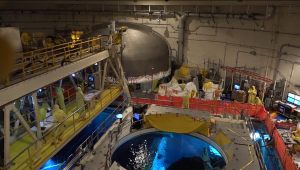
Image courtesy of NASA







Join our community. To comment on this article please join/login. Here's a sample of the comments on this post.
"This picture isn’t a joke, it’s an actual shot of Russian security standing around a rocket that’s about to take Americans into space." Does this mean their new plan to conquer us is to send us all into space??? :p
The issue with the Webb is extrordinarily complex on many levels. Technically it's the most complex machine ever put in space. It has to put itself together once it gets to it's position almost a million kilometers away. There is no way to launch any kind if repair mission. The mirror is made up of segments that must be positioned within .00001mm accuracy. The optical train and detectors the same. The solar array is huge and must be unfurled perfectly. The positioning and other mechanical elements ditto. Any one element fails and at best the scope will not operate to design parameters and at worst be an inner sculpture. Yes, NASA should be more realistic but do you think a realistic schedule and budget would have survived the gauntlet of red tape and politics where go/no go decisions are made by people who failed high school science? Where "optics" means "do I look great!" I think NASA did the best they could possibly do during the proposal phase but the project has so many firsts that an accurate schedule would be impossible. Add on top of that the embarrassing joke of Hubble is still fresh after 20 years, I'm amazed the Webb was ever a go.
With our massive debt, many govt programs have been reevaluated and cut, NASA has been one of them all through the years, but it's not a wise plan to cut their spending. Investment in NASA is a growing need as space becomes an obvious new area of military importance, along with, or course, all the great discoveries of our cosmos. NASA stimulates the economy through the purchase of goods and the creation of jobs, and many industries have flourished because of technologies and materials invented by NASA. They have difficult, nearly impossible tasks, but so many have succeeded. Just think of all the satellites in orbit, and all we use from cell phones to GPS etc that require them, and they came from advances NASA made years ago. And who knows what new advances in science and technology NASA will make to help launch us ahead in the future. And what about that asteroid that wiped out the dinos? If one of those suckers starts approaching somewhere down the road we sure will want NASA to be strongly up and running, and we won't give a damn how much it costs! The private companies are great, hope they make much progress, but NASA should be a continuous govt funded agency for space exploration and public safety that puts our country first. I understand that NASA needs to start delivering on realistic timetables, but it's got to be difficult predicting incredible feats of science and technology when you can't count on or be sure of the amount of support you'll get year by year. I can think of many programs that should be cut, but not NASA, it's such an important investment for our country and our future which can produce great dividends. Excellent op-ed, full of important points to consider, thanks Alex!