Amid heightened tensions between the U.S. led coalition and Russia in the air over Syria, a NATO F-16 fighter attempted to intercept a jet, believed to be a Tu-154, carrying Russia’s Defense Minister, Sergey Shoygu, over the Baltic Sea in Northeast Europe.
According to reports, the F-16, which may belong to the Polish Air Force, approached the aircraft initially, but was warned away by an armed Su-27 fighter jet that was escorting the Russian official’s aircraft.
NATO has not yet made an official statement regarding the interaction, but according to Russian journalists traveling with the Defense Minister, the aircraft was flying over international waters en route to the Russian enclave of Kaliningrad to meet with government officials about Russia’s defenses on the Western Flank.
As the NATO F-16 approached, one of possibly multiple Su-27s flying in escort positions placed itself between the approaching fighter and the government jet. Once clearly within the eyeline of the F-16, the Su-27 pilot reportedly tilted his aircraft to show the NATO fighter that it was armed. Approximately a minute after that brief interaction, the F-16 departed the area.
Kaliningrad separates NATO allies Poland and Lithuania except for a stretch of approximately 65 miles of farmland, woods and low hills known as the Suwalki Gap. Latvia and Estonia, also members of NATO, lie north of Lithuania, meaning that short expanse of land provides the only ground based supply route to the Baltic States. If the Russian military were to launch an offensive from Kaliningrad, they could potentially cut Lithuania, Latvia, and Estonia off from their NATO allies, making their eventual capture a likely possibility.
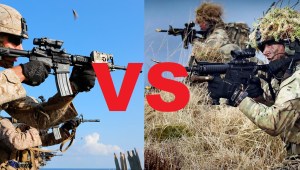
In order to ensure such an event does not occur, the United States Army and British Royal Marines joined soldiers from Poland and Lithuania to execute a series of war games and exercises intended to prepare the diverse force to work together in order to counter a Russian incursion. These exercises, which include U.S. led medevac drills, are intended to not only serve as a means to increase international cooperation within NATO, but to dissuade Russia from considering such an attack.
Of course, Russia has made a number of public statements indicating that these latest exercises, like the overall bolstering of NATO defenses along Europe’s eastern borders, are aggressive actions brought about by a growing anti-Russian sentiment in the West. Russia, of course, does not acknowledge repeated statements from NATO nation leaders regarding the reason for their heightened security concerns: Russia’s military annexation of Crimea in 2014.
An armed Russian Su-27 fighter jet intercepted an unarmed US Air Force RC-135 reconnaissance aircraft over the same waterway one day prior, coming to within five feet of the American aircraft’s wingtip in an encounter the U.S. government has categorized as both “unsafe and unprofessional.” U.S. officials even went so far as to accuse the Russian pilot of having “poor control” of his aircraft.
Of course, these interactions are remarkably peaceful compared to Russian threats in Syria – where U.S. jets have shot down two armed Iranian drones and one Syrian Su-22 in defense of coalition backed forces. As a result, Russia has declared that they will target any U.S. aircraft flying in their vicinity West of the Euphrates River.
No U.S.-Russian intercepts have occurred over Syria thus far, but concerns remain high that American fighters could potentially find themselves facing off against Russian jets. Such an altercation would certainly have significant effects on U.S.-Russian relations, and could potentially lead to war.
You can see a video of the interaction between the NATO F-16 and the Russian Su-27 below.
Image courtesy of YouTube







Join our community. To comment on this article please join/login. Here's a sample of the comments on this post.
Mustang Voodoo 1 Thanks for the reply. I appreciate it. I get that a RC-135 would not be armed. In fact I didn't think aircraft like AWACS, Tankers, etc... could even be armed and usually relied on other aircraft for protection. Your comments above seem to support that thinking. My question is why the NATO F-16 (or any other fighter aircraft) wouldn't be armed in the world environment we're in today. That just seems to lack common sense. Like a policeman patrolling the block with an unloaded sidearm.
The unarmed US aircraft the article references being intercepted by a Russian SU-27 on the day before the articles main point was a USAF RC-135 recon aircraft. They like many within the Boeing fleet are rarely if ever armed (AWACS / KC135 tankers / RC135 RA) even when flying over hostile territory (Iraq / Afghanistan / Yemen / Somalia / etc...) The RC135 is the military version of the Boeing Dash 80 / Boeing 707 and although they are equipped with counter measures, they are not configured with external weapons systems
This may seem like a silly question (I'm an Army guy and not an Air Force guy) but why would us (or any of our allies) be flying fighter jets around unarmed in this current environment? This makes no sense to me with all the tension and international "bullying" that's going on right now. I think it makes us look weak, stupid, and God forbid if shooting starts dead pretty quickly with no way to defend ourselves. Not that I would expect that we would want to play chicken with them in the situation described in this article just because we were armed, but at least we could look serious and competent. Stuff like this drives me nuts. Reminds me of when I left Active Duty and was in the National Guard. 9/11 happened and they called up the Guard to pull security at Civilian Airports and such. They had us deploy with our rifles and pistols, but only gave ammo to the Officers and senior NCO's so no one would accidentally get shot (and loaded magazines had to be kept in an ammo pouch and not in a weapon). This seemed ridiculous (not to mention more dangerous) to me in the event that a real follow-up terrorist attack occurred, but the chain of command said it was too risky to arm the soldiers around the public (due to the chance of a possible negligent discharge or accidental shooting) so it was better that we just appear to be armed with empty magazines in our rifles and look serious and menacing. If our soldiers aren't well trained enough to be trusted with loaded weapons in public then we have SERIOUS issues with training or trust (or maybe both). Now I'll be he first to admit that when I was in Bosnia, or even on the live fire range, I saw the occasional soldier shoot a live round into the safety check barrel who swore they properly cleared their weapon when exiting the hot zone. These exceptions are not a reason to leave our troops unarmed in the face of danger however. It's a reason to train longer, harder, and better. Needless to say my personal experiences after 9/11 are when I knew political correctness and sensitivity training were officially destroying the military and shortly after I switched to the inactive reserve and later resigned my commission. Sorry to spin out on a tangent but I thought it was relevant to my question as I had hoped with all the war fighting we've been doing over the past 15 or 16 years we would have learned better than what I saw immediately following 9/11.
No matter the NATO member state that the F-16 belonged to, NATO knew who's plane that was, and who was likely on board. The ballsy F-16 driver didn't even flinch when the Russian jet showed weapons, and stayed for a long minute afterwards.