I’ve received many inquiries about the equipment that I and fellow Special Forces soldiers carried when we ran top-secret reconnaissance missions into Laos, Cambodia, and North Vietnam during the eight-year secret war under the aegis of Military Assistance Command Vietnam Studies and Observations Group (MACV-SOG), or simply SOG. Most are curious about the state-of-the-art weaponry, communications, and surveillance equipment that we tested at the time—some of which we used in the field.
First, I turned to Lynne M. “Blackjack” Black Jr., to see what he carried as a conventional infantryman in South Vietnam with the 173rd Airborne Brigade during 1965 and 1966. After his tour of duty with “The Herd,” Black returned to Vietnam and served on various recon teams from 1968-1970 at FOB 1 and later, CCN.
Referring to his time in the 173rd, Black said, “When we went out on patrol, the enemy could hear us coming a mile away. The canteens were metal, with a metal chain that attached the black plastic cap to the body of the canteen. The metal canteen sat inside of a metal cup. As we walked, that chain would bang on the canteen, and the canteen sometimes rattled inside the metal cup. A squad of guys sounded like a Chinese drum line. Our weapon sling swivels would bang on the weapons, providing even more noise. Dog tags would rattle as we walked.”
The paratroopers also wore metal helmets with the paratrooper chinstrap and plastic helmet liners. Many paratroopers smoked and used Zippo lighters, which had a distinct, metallic clicking sound when opened and closed. They also wore jewelry such as silver- or gold-colored watches and rings, and carried entrenching tools and L-shaped flashlights that attached to the upper web gear and often got caught in the brush. At night, if available, they would drink beer or soda from tin cans that had to be opened with a can opener, as there were no pull tabs on drinks at that time.
The infantrymen also carried sleeping bags, gas masks, bayonets, personal knives, and rubber ponchos that were rolled and folded onto the back of the pistol belt. It provided a cushioned seat for sitting, but also a hiding place for small snakes, leeches, spiders, and other jungle insects and creatures. Some paratroopers carried the Claymore mine, a hand generator, a PRC-25 radio, compass, maps, and a protractor. The basic ammo load for the M-16 or M-14 was 200 rounds plus hand grenades. Some wore heavy armored vests that absorbed water and were hot as hell, often quickly dehydrating the young soldiers.
The early paratroopers also wore their jump boots that Black called “fungus factories.” Jungle boots, with canvas sides and a metal plate in the sole, were standard issue when I arrived in South Vietnam in April, 1968. The early paratroopers also wore military-issued underwear that caused rashes and infections, and socks that caused a foot fungus that some are still fighting today. It wasn’t until a visit from the secretary of state, who developed the fungus, that a cream was developed to fight it.
Nearly everyone smoked in those days. Five cigarettes were packed in neat little packs with each C-Ration meal. The smell of American cigarettes in Southeast Asia was unmistakable.
Louis J. DeSeta also served with the 173rd in 1967 before he volunteered for SOG duty.
“We were noisy as hell in the 173rd. We used to carry those metal ammo boxes that always banged against the metal canteens. Even taking a drink of water with the metal canteen made a metallic noise that could be heard off in the distance. A lot of us carried a poncho, but often didn’t use it in the field because they were so noisy when you unfolded them. And, once it started to rain, the rain hitting them gave off a different noise that the enemy could hear. SOG was just the total, complete opposite. We carried nothing that made any noise. Everything was taped down or tied down.”
DeSeta and Black agreed that the men who served in the early phases of the war had to learn what not to do and pass along their lessons learned to the FNGs.
Stuff we didn’t carry in SOG operations
To avoid rashes, infections, and fungus, Black and I didn’t wear underwear or socks. No SOG recon men wore helmets, helmet liners, or armored vests of any sort. Most of us didn’t carry entrenching tools, bayonets, sleeping bags, hammocks, ponchos, poncho liners, or air mattresses because they added weight to our total load. I weighed my gear on a small scale once at Phu Bai, and it weighed approximately 90 pounds. No one on ST Idaho carried an M-16, an M-14, or a 9mm weapon as his primary weapon.
For all missions, we never carried any form of identification: no dog tags, no military ID cards, no letters from home—nothing with any personal information on it. Our uniforms were sterile: No rank, no unit designator, no jump wings, no CIB, or South Vietnamese jump wings were displayed. Our green beret remained at FOB 1. We took extreme measures to ensure that our anonymity remained intact to provide deniability to the U.S. government in the event we were killed or captured. We cut out the section of a target map to carry to the field, thus only showing the grid in the target area, with no further information about the map or the cartographers who produced them. Additionally, we never smoked or cooked in the field.
Stuff SOG recon men carried
The most important piece of equipment we carried was the CAR-15. That was the preferred weapon of choice by everyone on ST Idaho. The sling for it would vary: Sometimes I used a cravat or a canvas strap taped tightly to both ends of the weapon for soundless movements. The only exceptions to the CAR-15 were an AK-47 carried by “Son” when he was our point man (he also wore an NVA uniform to complete the look) and an M-79 carried by our grenadier. In November 1968, Henry King carried the experimental pump M-79 weapon on one mission. It held up to five rounds of 40mm high-explosive ammunition. His secondary weapon was the Model 1911 Colt .45. On occasions, Black would carry the M-60 machine gun.
Every American on ST Idaho carried a sawed-off M-79 for additional firepower. We thought of it as our handheld artillery. During patrol, the Americans would load a special M-79 round with flechettes or double-ought (00) buckshot for close contact. The sawed-off M-79 would be secured either with a canvas or rope lanyard, or using a D-ring that was covered with black electrical tape to prevent any metallic banging. During the fall of 1968, I had a one-of-a-kind sawed-off M-79 holster, which I lost when I was unconscious during a rope extraction in Laos.
I would carry at least thirty-four 20-round magazines for the CAR-15. We only placed 18 rounds in each magazine, which gave me 612 rounds for that weapon, and at least 12 rounds for the M-79. The CAR-15 magazines were placed in ammo pouches or cloth canteen pouches, with the bottoms facing up to prevent debris from getting into the magazine, and all of the rounds pointing away from the body. We taped black electrical tape to the bottom of each magazine to make it easier to grab them out of the pouch during firefights. I also carried 10 to 12 fragmentation grenades, a few of the older M-26 grenades, the newer M-33 “baseball” grenades, and one or two V-22 mini grenades.
For headgear, I only wore a green cravat, a triangular bandage, on missions. It was light, didn’t get caught on jungle branches or knocked off my head by prop wash, and it broke up the color of my blond hair. As a practical matter, it kept the sweat out of my eyes. Hats didn’t do that. I often wore camouflage “paint” on my face.
I wore the traditional Army jungle fatigues because they dried more quickly while on the ground than the camouflage fatigues available at the time. I had the Phu Bai tailor sew an extra zipped pocket on the upper right and left arm where I carried pens, notebooks, pen flares, one plastic spoon, and my signal mirror. The tailor also sewed zipped pockets between the front top and bottom buttoned pockets, where I’d place maps, morphine syrettes, an extra notebook with any mission specific notes, and the URC-10 emergency radio.
On my right wrist I wore a black, self-winding, luminescent Seiko watch, which was so bright at night that I wore it face-down on the bottom of my wrist, under my glove. Thus, even in the pitch black jungle, I knew when to make communication checks with the airborne command aircraft, usually at midnight or at 2 a.m. In the jungle, I always wore black contact gloves for protection against jungle plants, thorns, and insects. I cut the thumb, index finger and middle finger off of the right glove down to the first joint for improved grip. I always wore an extra cravat around my neck.
On my left harness strap, I taped my KA-BAR knife, with handle facing down; hand grenades; small smoke canisters; and a sterile bandage. On my right harness strap was a strobe light, held in a cloth pouch; hand grenades; a rappelling D-ring; and a smoke grenade. My preferred web gear was the WWII BAR (Browning Automatic Rifle) ammo belt and shoulder straps, because five CAR-15 magazines fit snugly into each individual pouch. One pouch would be used for M-79 rounds. A plastic water canteen in a cloth canteen holder fit onto the belt, as well as one white phosphorous grenade and my survival ax.
The amount of water available in the AO would determine how many plastic canteens of water I’d carry to the field. One canteen would have a small bottle of water purification pills taped to it. I used those pills for all water outside of camp. In our AOs, the water was often tainted with the defoliant Agent Orange. We hoped the purification tablets would counteract it. On the right side of my harness I always carried the Frank & Warren Survival Axe Type II, MIL-S-8642C. I preferred it to the machete because the backside had a nasty, sharp hook that cut through jungle vines on the return swing. I carried my folding compass around my neck, held by green parachute cord.
I used a cravat as a belt or a cut-down green cargo belt because they were silent. In my right pocket was the Swiss Army knife secured by a green parachute cord to a belt loop on my pants. Because I always wore the bulky gas mask bag on my left side, which held the black M-17 gas mask, I rarely put anything in my upper left pocket. (If the charcoal air filters on the M-17 got wet, they had to be replaced.) In my lower left pant pocket I carried small and large colored panels to mark our position for Covey and tactical air strikes.
In my lower right pocket were extra pen flares, a dehydrated Long-Range Reconnaissance Patrol Ration (LRP or LRRP, pronounced “LURP”), bug repellant to squirt on leeches, and an extra cravat and sterile bandage. I always carried the Swiss rope. The 12-foot section of green-colored rope was used as a Swiss seat for extractions by helicopter. We would hook a D-ring through the seat’s rope and onto 150-foot-long pieces of rope that hung from the chopper.
On all missions, I carried the PRC-25, our primary radio contact with the outside world. It took up the most space in my indig rucksack. Most times, I had the short, flexible antenna screwed into it, which I folded under my right arm and tucked into my jungle fatigue jacket. I did this because the NVA always searched for the radio operator, knowing he was the primary link to U.S. air power. I carried the long antenna, folded in sections, in my rucksack.
Other items included one can of C-Ration fresh fruit, either peaches or apricots; extra hand grenades; the remainder of my CAR-15 magazines; extra M-79 rounds, including one tear-gas round; an Army long-sleeved sweater; a thin, hooded, waist-length plastic rain jacket; and toilet paper. Both the sweater and rain jacket would be folded under the PRC-25 to buffer where it hit my back. I also carried an extra PRC-25 battery, an extra URC-10 battery, extra smoke grenades, an extra canteen of water if needed, and extra LURPs.
On a few occasions, especially when we ran targets in Cambodia, which was flatter and more wide open, I’d carry a Claymore mine and a few pre-cut fuses—five-second, 10-second, and longer-duration fuses—used to break contact with enemy troops chasing us. On several occasions I carried .22-caliber High Standard semi-automatic pistol with a suppressor for ambushes or to kill enemy tracker dogs. I also carried cough syrup for team interpreter Nguyen Cong Hiep or anyone who coughed at night, cans of black pepper and powdered mace for enemy tracker dogs, and a compact toothbrush.
There were some redundancies, such as bullets, bandages, and smoke grenades, carried in various locations on my body because each could be crucial to surviving a firefight and successfully directing helicopter gunships, F-4 Phantom jets that delivered ordnance on target faster than the speed of sound, and the old deadly propeller-driven A-1 Skyraiders.
The emphasis was packing firepower for survival. I preferred to go hungry instead of running out of ammo. Items for creature comfort were discarded in favor of carrying an extra grenade or a high-explosive M-79 round. Why?
In the Prairie Fire AO, there were several times when we were in contact with NVA troops for two or three hours before making radio contact with Covey or any U.S. aircraft. Then, depending on weather and the status of other teams in the field, there would be further delays in getting air assets on-scene, especially when the team was surrounded and there were no routes for escape and evasion. On most missions, I preferred six-man teams due to helicopter extraction considerations: height, altitude, weight, and weather conditions dictated how many men could board an extraction chopper.
The type of helicopter used for the extraction could vary from the old H-34s to Hueys, or on rare occasions, the Air Force’s HH-3 Jolly Green Giant—the larger, more powerful chopper during that war. On very rare and unique missions, SOG recon and Hatchet Force teams would use the largest helicopter available: the CH-53 Sea Stallions based in Da Nang with the Marine Corps HMH-463 unit. Which one picked up the team, usually under heavy enemy gunfire, made a difference in regards to how many men it could carry in extreme weather conditions. And, to the man, every air crew SOG team members worked with was fearless, always willing to put their lives on the line for SOG teams.
There were at least two missions where, upon ST Idaho getting extracted from the target, I was down to my last CAR-15 magazine, M-26 grenade, and M-79 round. The NVA were relentless and fearless.
We had an intimate knowledge of all the weapons we carried to the field. Not only did we know how they worked, but we could dismantle them and clean them at night—that was mandatory training, not optional. We fired thousands of rounds through our CAR-15s and M-79s during live-fire reaction drills and while firing at static targets. Before we carried any new weapon or device into the field on a mission, we practiced using them for hours in order to gain familiarity with them and to see how they functioned under repetitive conditions. We also trained on enemy weapons we’d encounter on missions: the AK-47, RPD, B-40 grenade launcher, and the older SKS rifle.
With ST Idaho, if the team wasn’t on a mission, we were training on the range or doing local training patrols, which included both silent and live-fire reaction drills.
For wiretaps, ST Idaho Vietnamese team leader Nguyen Van Sau was the quickest team member to climb an NVA telephone pole or tree to install a wiretap. He trained several other men on the team, including Phouc, Hung, Quang, and Son. They had to climb the pole, install the wiretap, and cover the wire leading from the telephone wire down to our cassette tape recorder with mud or wood putty to hide it from passing enemy troops.
For Bright Light missions, we carried extra rounds, hand grenades, Claymore mines, bandages, medical supplies, and at least one machine gun. We carried one canteen of water, but no food.
On a few missions we carried anti-tank and anti-vehicular mines. Before going to the field, Black or Shore would spend hours cross-training our Vietnamese team members to ensure they’d install the devices as quickly as possible without detection by enemy troops while the remainder of the team provided security for them. On those missions we’d usually carry at least one M-72 Light Antitank Weapon (LAW), but only after the entire team had drilled on them for several days.
For POW snatches, ST Idaho spent hours practicing setting up the jungle ambush. This entailed each team member quickly placing a Claymore mine in the kill zone and for flank security, in addition to installing the pre-cut block of plastic explosive that would knock out an enemy soldier. The Claymore mine, officially designated the M-18A1 fragmentation, antipersonnel mine, weighed 3.5 pounds and contained 1.5 pounds of plastic explosive, which propelled 700 steel balls in a deadly, killing arc that was dangerous out to 250 meters.
Throughout 1968, there were experimental weapons that S-4 shared with recon men for our assessment of their performance capabilities, such as the Gyrojet rocket pistol that fired a 13mm round similar in gauge but longer than the standard .45 caliber round. There were many variations of silenced weapons such as the M-1 carbine, the old WWII Sten submachine gun, the 9mm Karl Gustav Swedish K submachine gun, and the XM-21 sniper rifle.
We had various night-vision devices, the Starlight scope, and the experimental pump M-79 weapon. The Air Force and the CIA often came to us with experimental explosive devices, communications equipment, and various trail sensors. In the early ’70s, the Air Force used the recon teams’ experiences combating the NVA at night to design complicated enemy-targeting devices, some of which lead to technology used in the wars in Iraq and Afghanistan following the terrorists attacks on the Twin Towers in New York City on Sept. 11, 2001.
Sometimes team members were issued devices that were unknown to me. For example, in 2005, Doug LeTourneau told me about a team perimeter security device that he carried with him on all missions. It was a small box that held a small strand of nylon filament he placed around the team’s perimeter. He would place the listening device near his ear. If a person or an animal walked through the team’s perimeter, it would sound a barely audible alert signal.
For a short period of time, Black used a seismic alert system made up of four probes, each emitting its own signal. He had a receiver in his breast pocket with an ear jack that allowed him to hear the warning signals from each probe. Unfortunately, if it was used in grassy areas, any wind moving the grass would set off the probes, falsely indicating the team was surrounded. Once we discovered this flaw in the system, it was abandoned. Not all technology worked out.
LeTourneau also reminded me that he took “no-shit” pills before a mission, which prevented bowel movements. I didn’t use them. Enough said on that topic.
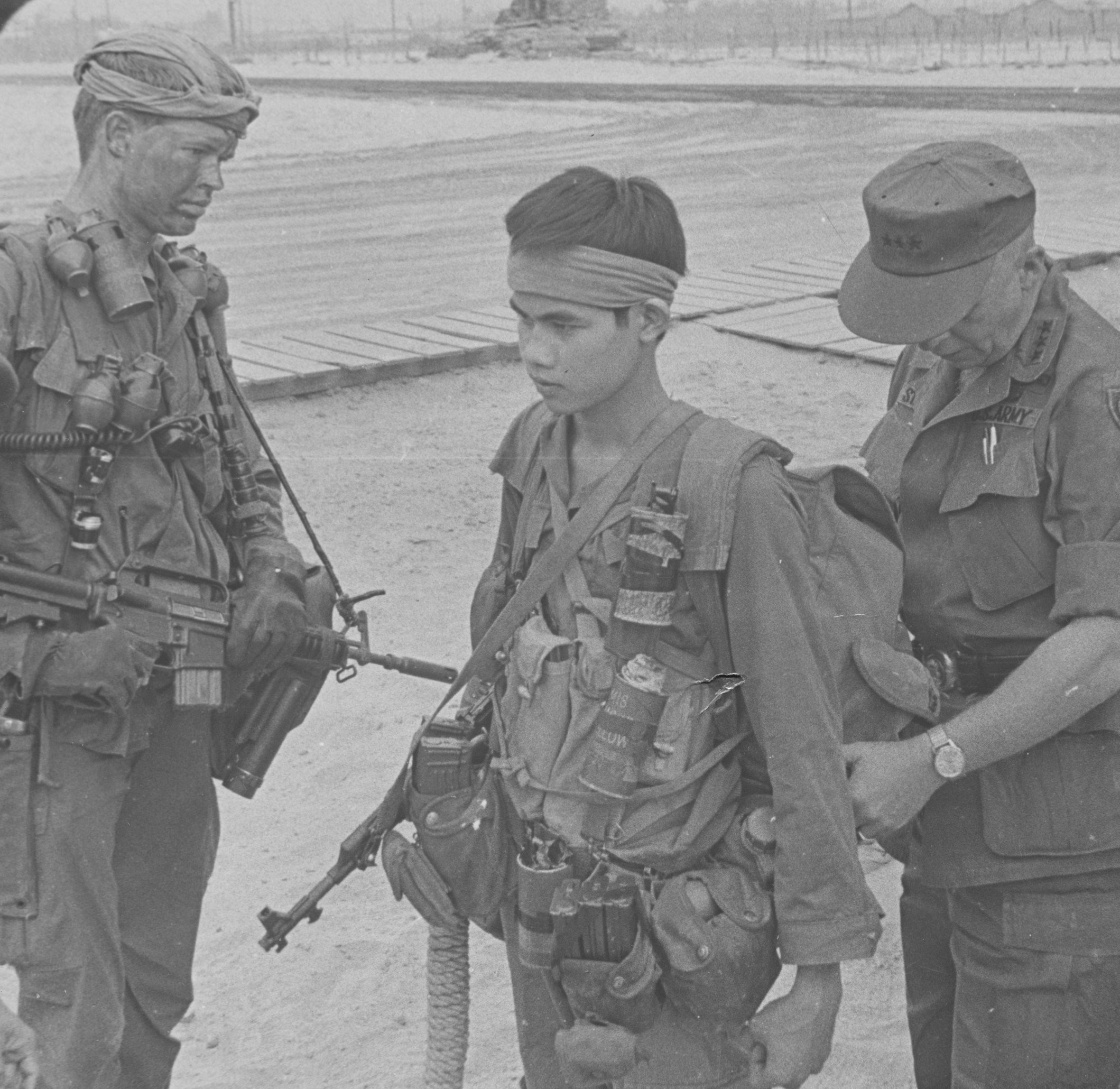
(Featured image: Author John Stryker Meyer, left, is wearing a WWII-era BAR ammo belt, which held five CAR-15 20-round magazines. Note the canvas canteen pouch hanging on the left, which contains hand grenades. Lynne M. Black Jr., shown on the right, has his CAR-15 with an XM-148 40mm grenade launcher attached to it. The XM-148 fired the same round as the M-79 grenade launcher. Both men are wearing camouflaged fatigues, generally worn in camp and for in-country training. Both are wearing jungle boots that had metal plates in the bottom to protect against punji stakes.)


Join our community. To comment on this article please join/login. Here's a sample of the comments on this post.
My goodness this is badass.
AMAZING STUFF! I was a grunt in the Delta back then and much of this is quite familiar. Almost killed my LT for his CAR15... was not allowed to turn my 79 into a pistol..too much fuckin noise most times..no mini frags... crossed the Mekong into Cambodia on a Navy supported op... scared shitless more than once. Thanks man.. great story and history!! Glad you came home!!!
I was fortunate, I never had to ditch my gear while being pursued. When I was extracted on ropes from a target, I got turned upside down & passed out. I only fell a few feet before hitting ground. My teammate took off my gear, carried my unconscious ass to the chopper and we left Laos post haste. When I regained consciousness, I was happy to be alive, unhappy about loss of gear.
John, did you ever have to drop all your gear for an E&E and did you have your rig set up so that you could dump certain things while keeping others? And what would you keep?
This is what my friend sent me in an email when I asked about this topic: "I was with MACV MATA, a sister of MAVC SOG. Our 4 and 6 man teams operated along the border, or as it was called: the fence. I had four Americans advising an ARVN artillery battalion which supported the ARVN's 5th Rangers, with 6 other Americans. I worked at both ends: sometimes with the artillery FDC and sometimes as the FO with the Rangers on operations. We would do general sweeps, search-and-secure, and set up traps along the fence, and bait the NVA, as they would bait us. We occasionally, but not very frequently, worked with the MACV SOG teams. The SOG teams were classified as mercenaries because they were operating across the fence or outside of our legal boundaries, and therefore they could not legally call on us to come in to support them. Basically, they were recon teams, illegal recon teams made up mostly of Vietnamese, Cambodians, Chinese, and assorted native mercenaries with 3 American NCOs, none wearing any ID. When they got in trouble, it was bad, and there was not much recourse. If they got back to the fence, we could pick them up, and/or support them. But in effect, they were the recon teams; we were the combat teams. If we or they could find enemy units, if we or they could observe the enemy enter our legal territory, then it was up to my ARVN units to trap or engage them. I arrived in August 1968, four months after Tet. The VietCong and NVA had been literally destroyed during the Tet offensive. Therefore, during most of my two tours, we had very little enemy action. We captured odds and ends, we engaged small squad-sized units, we ambushed 3 and 4-man teams, we rescued downed pilots, and once, but just once, we stumbled upon a battalion-sized enemy unit preparing to attack an American artillery base. SOG. I knew them, as I did the Ravens (look that one up), and the FOBs where I did some translations, but we all mostly kept our distance, as we had to. Most of us also signed 20-year non-disclosure documents, and most of those guys were 20-year career men anyway, so after the 20 years, who the hell cares. PETE"