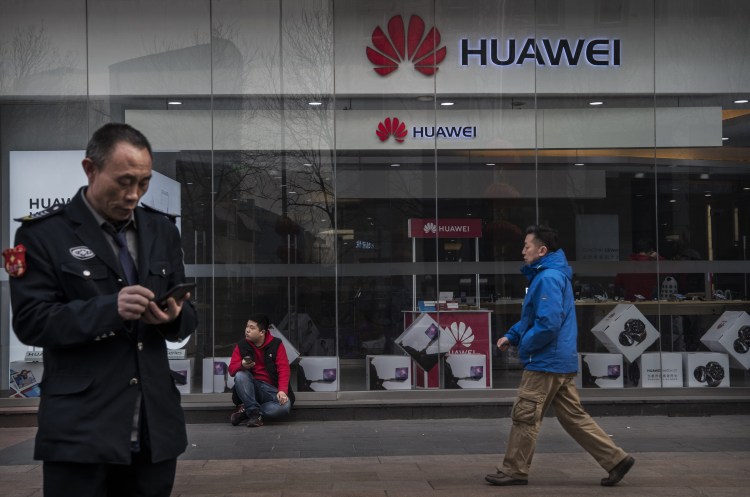
Chinese telecom giant Huawei filed a lawsuit against the U.S. government, claiming the National Defense Authorization Act banning the installation of their hardware in federal defense systems is unconstitutional.
The lawsuit complaint states:
Plaintiffs Huawei Technologies USA, Inc., and Huawei Technologies Co., Ltd. (collectively, “Plaintiffs†or “Huaweiâ€), by and through their attorneys, bring this action under the United States Constitution and 28 U.S.C. §§1331, 2201, and 2202, seeking a declaration that – 2 – pertinent provisions of section 889 of the John S. McCain National Defense Authorization Act for Fiscal Year 2019, Pub. L. No. 115-232 (“NDAA†or “2019 NDAAâ€), that define certain equipment and services produced or provided by Huawei Technologies Co., Ltd. and its subsidiaries and affiliates as “covered telecommunications equipment or services,†id. §889(f)(3)(A), (C), and consequently restrict the procurement and use of such equipment by executive agencies, federal government contractors, and federal loan and grant recipients, id. §889(a)-(b), are unconstitutional. Plaintiffs also seek an injunction and any other appropriate relief.”
It should be noted here that in China, there’s not a true separation between government and commercial enterprise. Political power in China is centralized under the Communist Party, and Chinese corporations all nominally answer to this structure.
In this system, there’s no such thing as private enterprise as Americans understand it. U.S. defense and intelligence officials have repeatedly warned that Huawei is used as an intelligence gathering apparatus by the Chinese government, and that the company is attempting to dominate 5G cellular network infrastructure.
Amazingly, Huawei’s lawsuit has several paragraphs after the initial complaint lecturing the courts about the framers of the U.S. Constitution; the intent of the founding fathers; and the separation of executive, legislative, and judicial powers—including a claim that this never would have been tolerated in the Chinese system of government.
This approach follows a trend, in that the Chinese strategy attempts to weaponize America’s freedom against itself, taking advantage of our relative openness as a country and willingness to act in good faith. It’s no mistake that our country’s attempts to combat Chinese espionage are often met with complaints about racism. Representatives of the Chinese government have studied our culture closely, and they understand that racism is an argument that carries currency with sensitive Americans.
It now appears that China’s espionage machine is trying to recruit Thomas Jefferson and George Washington to their cause.


Join our community. To comment on this article please join/login.
Here’s a sample of the comments on this post.
I did see your comment on the freq. haven’t replied yet.
I don’t feel that any protections under the US Constitution should apply to any foreign/non citizen and/or foreign owned companies. What would or wouldn’t be tolerated in China is irrelevant seeing as this isn’t China. I don’t like how so many electronic devices in all aspects of American life including National Defense are riddled with foreign tech (transistors, capacitors, processors, etc…) In my view that is a very huge vulnerability.
Just counter sue for counterfeiting all our tech, unless of course copying someone’s work is a thing in China. Maybe Mao was the biggest copycat of all time? I am sure he would sanction this.
Normally I’d say “yeah, good luck with that!” but these days…who knows. The courts themselves are to blame, if they weren’t acting extra-Constitutionally to being with we would literally not be in positions like this, they are out of control.
Mic-Mac,
Have I become that predictable? (Note, I posted item to Jack before I read your comment…)
Also: See reply to your suggestion yesterday on Freq…
Best,
-YP-