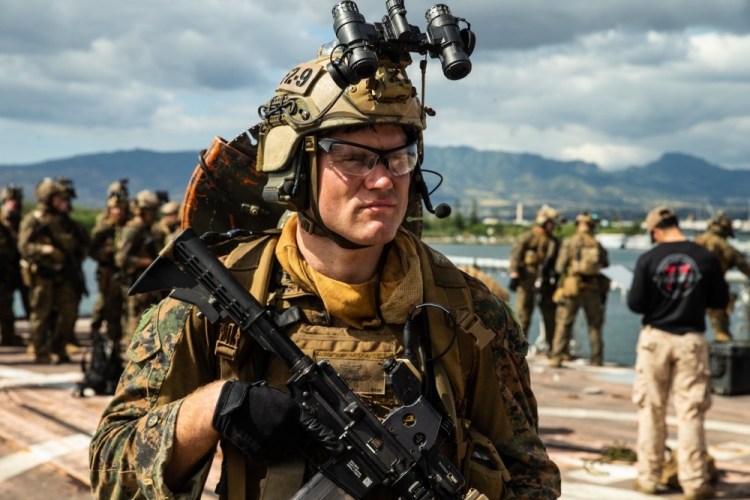
In an operation reminiscent of the Second World War’s island hopping, the U.S. Marine Corps conducted an amphibious and air assault against Iejima Island, a small Pacific island off the coast of Japan, seizing its airfield and strategic points in a rapid and aggressive operation.
More specifically, the 31st Marine Expeditionary Unit (MEU), Air Commandos from the 353rd Special Operations Group, and Green Berets from the 1st Battalion, 1st Special Forces Group, seized the island in an exercise that took place between March 11 and 14.
The operation is clear notification to China’s regional aspirations, and more specifically to its strategy in the South China Sea. That’s where the Chinese military has been manufacturing artificial islands in an attempt to create a defensive shield around the Chinese mainland and protect it from the U.S. Navy’s aircraft carriers.
During the exercise, Force Reconnaissance Marines conducted a free-fall parachute jump to prove close target reconnaissance capabilities to the Marine commander. Afterwards, Marines air-assaulted the island’s airfield with CV-22 Osprey helicopters. The Air Commandos were then able to coordinate air resupply to ensure the force’s sustainability.
“We are not just going through the motions of partnering with other services in our training,†said Maj. Jacob Godby, the assistant operations officer of the 31st MEU, in a press release. “Our joint-service team makes the 31st MEU more ready and lethal, and helps prepare our Marines and sailors for a variety of missions as the forward-deployed crisis response force in the region.â€
The training exercise is part of the Expeditionary Advanced Base Operations concept, which is designed to allow Marine Corps units to operate from small forward-deployed bases in various Pacific islands.
Col. Robert Brodie, the commanding officer of the 31st MEU, said in the same press release: “The 31st MEU’s great relationships with Wing, Division and Special Operations Units ensures we are prepared for any crisis. Over the course of two weeks, the MEU aligned capabilities with these forces and led a small island seizure. We are ready to rapidly seize ground and project lethal combat power.â€
“The Indo-Pacific region is incredibly dynamic, so we prepare and train daily for real world crises,†added Colonel Brodie.
In a future conflict with China, which would most likely be centered in the South China Sea, the U.S. would be able to count on Australia to provide combat and logistical support. Since World War II, Australia responded to the inability of Great Britain to ensure its safety by willingly coming under the protective wing of the U.S.
This, of course, doesn’t mean that the Aussies are incapable of putting up a good fight if there’s a need. The Australian Defense Force is highly capable and professional. It has shown it can conduct successful unilateral operations, for example, in East Timor. More importantly, Australia has proven to be a loyal ally: it was one of the first countries to answer America’s call for help after the 9/11 terrorist attacks.


Join our community. To comment on this article please join/login.
Here’s a sample of the comments on this post.
If only those useless Marines contributed in large part to every conflict this country has had. Irrelevant and unnecessary.
That right? I must be way behind on current events.
The Army could easily put together a unit that conducts Amphibious landings, however the nation wants a Marine Crops not needs one. But the Marine Corps that taught Marines how to think, instead what to do, isn’t around anymore and this will untimely lead to an unneeded Marine Corps in the public eye next war.
Only way this changes is if the Close Combat Task Force recommends the right changes to the Infantry force as a whole.
Funny given that a former administration sought to get rid of the USMC. Amphib landings are a thing of the past they said.
Is there any strategy to just simply cut off an islands supply chain and let them surrender? I guess it all depends on the size of the island; but the US has a fleet of moving islands.